





(Except, Actually, It Kind Of Does)
Here’s a thought that will quietly wreck your afternoon as it did mine one day – so I started to dig the answers!
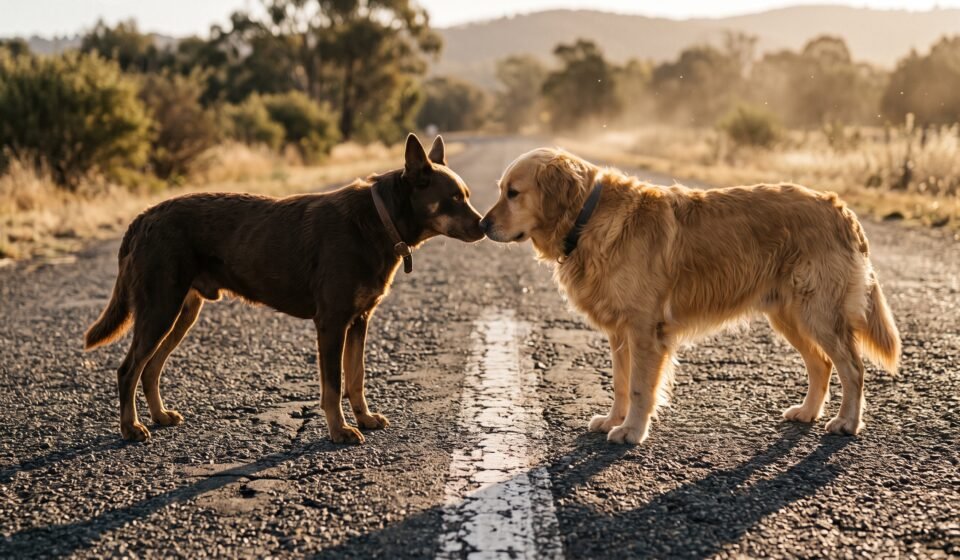
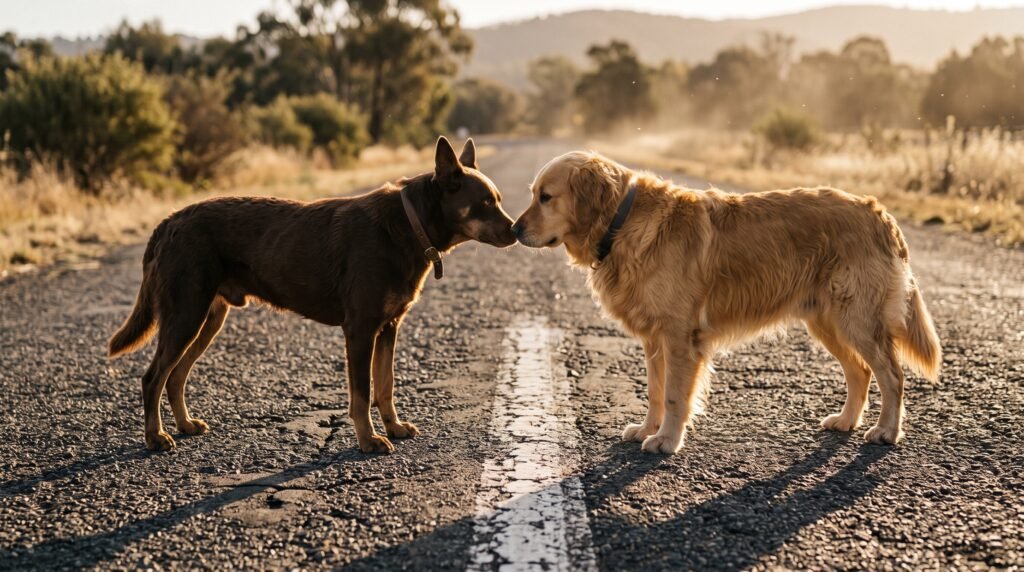
Take a puppy born in Sydney. Take another born in India. Ship one to the other. Put them in a park together. Within about four seconds they will have exchanged more meaningful information than two humans from those same cities manage in a first conversation. No translator. No app. No awkward pointing at a menu.
Now do the same with two human babies.
You’d get eighteen years of school, a shelf of grammar books, and two adults who can’t order coffee in each other’s country.
Nobody sits a dog down and teaches it to bark. There is no puppy classroom, no conjugation table, no irregular verbs. A dog is born loaded. The software ships pre-installed and it’s the same build worldwide. Meanwhile, the most intelligent species on the planet arrives with an empty hard drive and spends a decade downloading whichever local dialect happens to be playing in the room.
We call that an achievement. I’ve started to wonder if it’s a bug.

The blank slate is the weird part
Think about what human language actually costs us.
A baby born in Tokyo and a baby born in Toronto are, at birth, completely interchangeable. Swap them in the hospital and each will grow up fluent in the other’s tongue, accent and all, with zero trace of the “original.” That’s not a small thing. It means human language isn’t in us. It’s in the room we happen to land in.
Which means every human being is, at birth, locked out of roughly 7,000 conversations. You get handed exactly one key. If you want any of the others, you pay for them in years.
The dog gets the master key for free.
And here’s the part that stings: because our language is learned rather than inherited, it drifts. It splinters. Two villages on opposite sides of a mountain will be mutually unintelligible in a few centuries. Latin exploded into six languages and then those six stopped understanding each other. Our communication system has a half-life. Barking doesn’t.
A wolf howl from 40,000 years ago would still land today. A sentence in Old English from 1,000 years ago needs a footnote.
Okay. Now let me take it all back!
I built that whole argument and it’s about 70% wrong, and the missing 30% is far more interesting than the clean version.
Because some animals do have accents. And regional dialects. And, in at least one case, something disturbingly close to a flag.
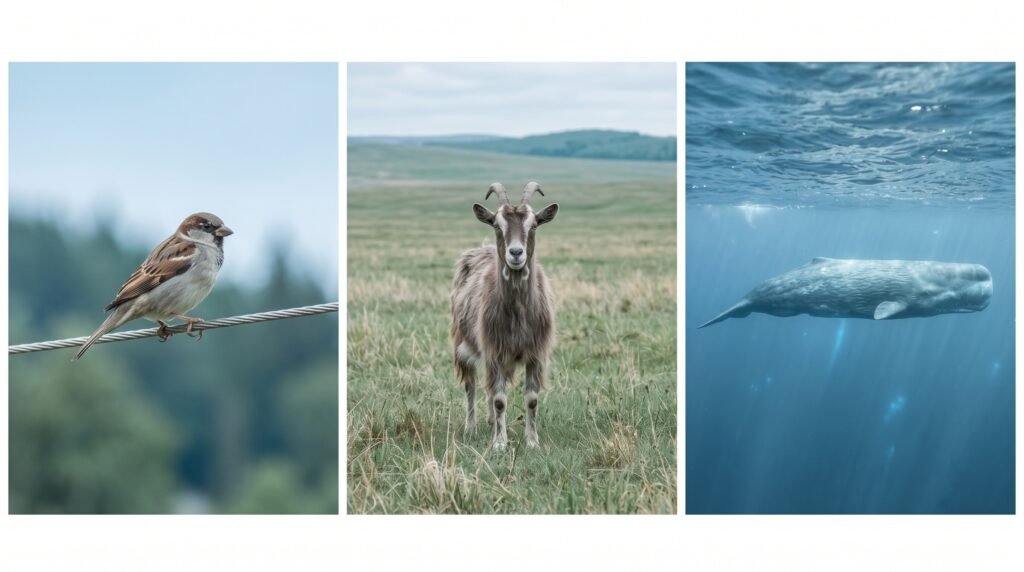
Sparrows have local accents. White-crowned sparrows learn their songs by listening, during a specific window early in life, the way human babies do. Raise one out of earshot of its own kind and it grows up singing something broken and wrong. Raise it in a different valley and it picks up that valley’s tune. Neighbouring populations sing measurably different versions of the same song — actual geographic dialects, mapped by researchers since the 1960s.
Goats have accents. A study out of Queen Mary University of London found that kids raised in the same social group converged on similar bleats — and that when they were moved into new groups, the accent shifted. Goats. Adjusting their voices to fit in with the crowd. That’s not instinct. That’s peer pressure.
And then there are sperm whales. They talk in codas — patterned clicks. Whales sort into “clans” spanning thousands of kilometres, and each clan has its own coda repertoire. Whales from different clans will share the same ocean and not socialise. Researchers have argued that certain codas function as symbolic markers of group identity — the whale equivalent of a scarf in team colours. Calves learn the clan dialect from the adults around them, not from their genes.
A sperm whale calf, adopted into another clan, would grow up speaking that clan’s dialect.
Just like the babies swapped in the hospital.
So what’s actually different about us?
Not learning. Learning is everywhere once you look. Songbirds, whales, dolphins, elephants, bats, some primates — vocal learning is scattered all across the tree of life.
What’s different is the ceiling.
A sparrow can learn its neighbourhood’s song. It cannot learn a song about a thing that hasn’t happened yet. A whale can inherit a clan dialect. It cannot use that dialect to describe a whale who died before it was born, or to argue about whether a thing is fair.
Humans didn’t invent learned communication. We inherited it and then removed the limit on what could be said with it.
Even the neat story we used to tell about why is falling apart. FOXP2 — the so-called “language gene” — was the tidy answer for two decades: a mutation swept through our ancestors and switched on speech. Then a 2018 study found no evidence for that recent selective sweep in humans at all. The gene matters. It just isn’t the origin story we sold. There’s no single switch. Language looks less like a lightning strike and more like a slow, messy accumulation nobody has fully mapped yet.
The bit I can’t stop thinking about
Your dog’s bark, incidentally, is mostly our fault. Wolves — genetically almost identical, same ancestor — barely bark. They howl, they whine, they growl, but the incessant barking that defines dogs is something that ballooned during domestication. We bred it, or at least amplified it, largely so animals would alert us.
Which flips the whole essay one last time.
The dog isn’t communicating universally. It’s mostly communicating at humans, in a channel we more or less installed. Two dogs in a park aren’t having a conversation in a global language. They’re doing what they’ve always done — smell, posture, tail, ear angle — and the barking is the part aimed at us.
So the universal dog language isn’t a language, and the humans with a thousand tongues aren’t handicapped, and the goats have accents, and the whales have flags.
The clean version of this idea is elegant, and it’s a lie. The messy version is that the line between “born knowing” and “learned from the room” runs through almost every species on Earth — it’s just drawn in a different place for each one.
We’re not the only ones downloading our voice from the neighbours.
We’re just the only ones who wrote an essay complaining about it.
Sources
PNAS — Evidence from sperm whale clans of symbolic marking in non-human cultures
Queen Mary University of London — Goat kids develop accents
Cell (2018) — No Evidence for Recent Selection at FOXP2 among Diverse Human Populations
Nature Reviews Genetics — FOXP2 tells a cautionary tale
University of Cambridge — Wolf species have ‘howling dialects’
Scientific American — Wolves Have Local Howl Accents
Merck Veterinary Manual — Social Behavior of Dogs
VCA Animal Hospitals — Canine Communication: Interpreting Dog Language
